The contributions of Archimedes
A few weeks ago I was browsing a couple of maths books – The Math Book by Clifford A. Pickoveas and The Joy of X by Steven Strogatz – as everyone does from time to time, and I kept coming across Archimedes’ name in connection with various concepts, discoveries, and inventions. I had heard of Archimedes before, but I don’t think I quite knew about or grasped the enormity of his influence on both science and maths. Ever heard of the Law of Buoyancy, the Law of the Lever, or Archimedes’ Screw? Yep, he’s behind all three – not to mention his ingenious approximations and geometrical insights.
Archimedes lived over two millennia ago, from around 287 to 212 BC. He hailed from the city of Syracuse in Sicily, and he worked as a mathematician, physicist, and engineer – quite the CV. He was what we call a ‘polymath’, an expert in multiple fields. If you are interested in learning about some of his main contributions to these fields, read on!
Archimedes’ Principle
Archimedes’ Law of Buoyancy, otherwise known simply as Archimedes’ Principle, is one of his most famous contributions to science, engineering, and mathematics – not just for its value, but also its fun origin story involving a bath and a gold crown. However, Armand D’Angour, an eminent scholar of classics, has argued that the story of the gold crown has usurped the more likely inspiration behind the principle, which is the construction of a ship called the Syracusia. Unlike the bathtub tale, which was recorded over 100 years after Archimedes’ death and lacked practical accuracy, the account of the Syracusia was written in great detail by a trusted historian, Moschion of Phaselis, who likely saw the ship himself, and later preserved by a trusted writer, Athenaeus of Naucratis.
The account goes that, in the third century BC, King Hieron II of Syracuse commissioned the Syracuse-born mathematician Archimedes to oversee the design and construction of the largest ship ever to exist – one that was roughly 50 times bigger than the average warship of the time. Not only was the ship gigantic, it was also tremendously heavy. It was carrying an ungodly amount of grain, pickled fish, water, and wool, as well as approximately 1,900 passengers, 20 horses, eight battle towers, a temple to the goddess Aphrodite, a promenade, a gym, a swimming pool, and a library. The primary question surrounding this pioneering project was: could a ship of this size and weight actually float? This is where Archimedes stepped in.
Archimedes found that, if the weight of the water displaced by an object is equal to the weight of the object, the object will float. The reason for this, as Archimedes discovered, is that the upward force acting on an object in water is always equal to the weight of the water it displaces. So, yes, even a ship the size of the Syracusia is capable of floating! With an approximate weight of 2,000 tons, the Syracusia needed to displace a minimum of 2,000 tons of water, though displacing more would ensure it would float with ease.
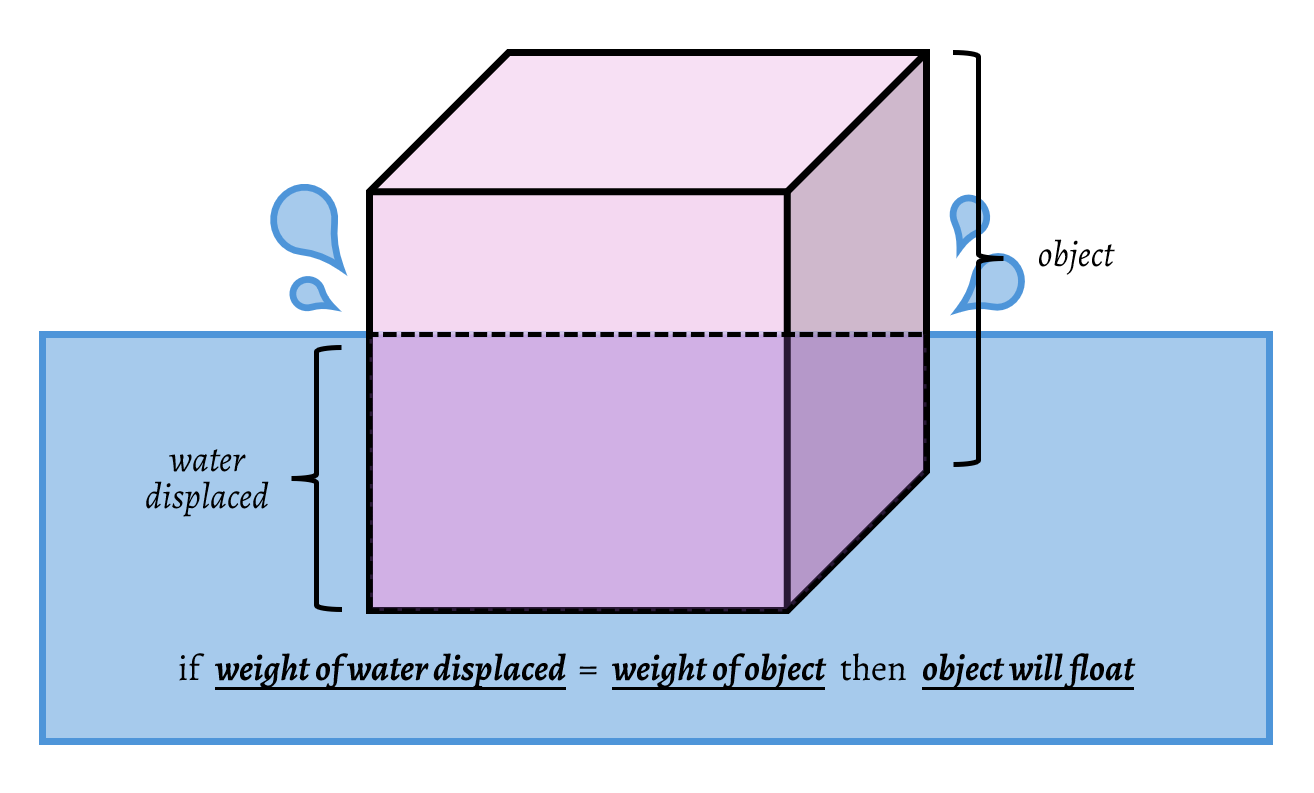
This principle is the basis of the field of fluid mechanics, the branch of physics concerning the forces of fluids, and a key component of hydrostatics, the branch of fluid mechanics concerning fluids at hydrostatic equilibrium (i.e. at rest).
Calculation of Pi
Another of Archimedes’ most outstanding achievements and contributions to mathematics relates to a number that is pretty familiar to most, if not all, GCSE maths students: pi.
Pi (π) is the ratio of a circle’s circumference to its diameter. In other words, a circle’s circumference is always pi-times longer than its diameter. This is a simple concept, sure, but calculating pi is no simple matter.
Archimedes, in his attempt to approximate pi, squidged a circle between two polygons like so:
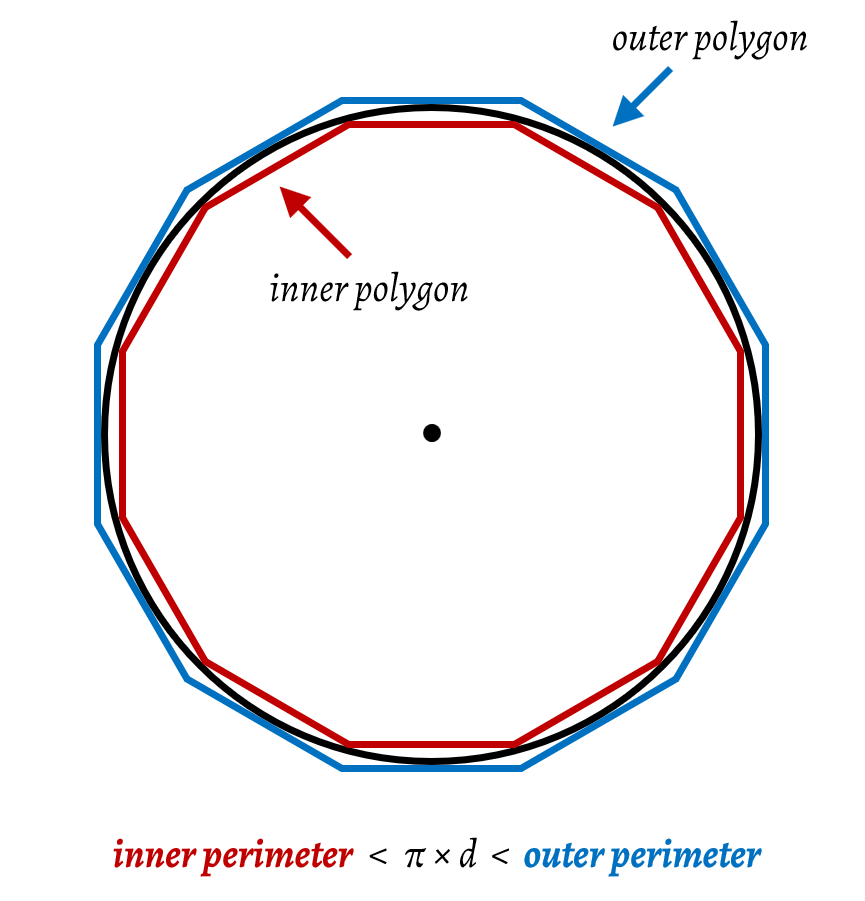
The idea is that the circumference of the circle is bounded by the perimeters of the two polygons: it will be longer than the perimeter of the inner polygon (i.e. inscribed polygon) and no longer than the perimeter of the outer polygon (i.e. circumscribed polygon). Archimedes applied geometric theorems – including Pythagoras’ Theorem – to find the perimeters of both polygons, which formed a range of values in which he knew pi must live. By doubling the number of sides of the polygons – from 6 to 12 to 24 to 48, and then finally to 96 – he considerably narrowed the range to between 3.1408 and 3.1429.
Today, we know the first 314 trillion digits of pi, but back then, knowing that pi lies between 3.1408 and 3.1429 was groundbreaking. Archimedes’ approximation remained the most accurate for hundreds of years.
Method of Exhaustion
Archimedes’ method of approximating the value of pi is an example of the method of exhaustion, a technique also used in classical antiquity to approximate the areas of 2D shapes. Building on the work of Eudoxus of Cnidus, Archimedes set about determining the area of a circle, ellipse, spiral, and the space under a parabola – areas that were previously deemed impossible to find.
To do this, he employed the aforementioned method of inscribing – and also sometimes circumscribing, as before – a sequence of polygons, the areas of which converge to (i.e. get closer and closer to) the area of the containing shape. By finding the area of each of these polygons, each time Archimedes is calculating a more accurate approximation of the area of the shape. Like before, the idea is that the area of the shape is bounded by the areas of the polygon(s): it will be greater than the area of the inner polygon and, if used, smaller than the area of the outer polygon. Any GCSE students familiar with bounds will recognise that the area of the inner polygon is the lower bound and – again, if used – the area of the outer polygon is the upper bound.
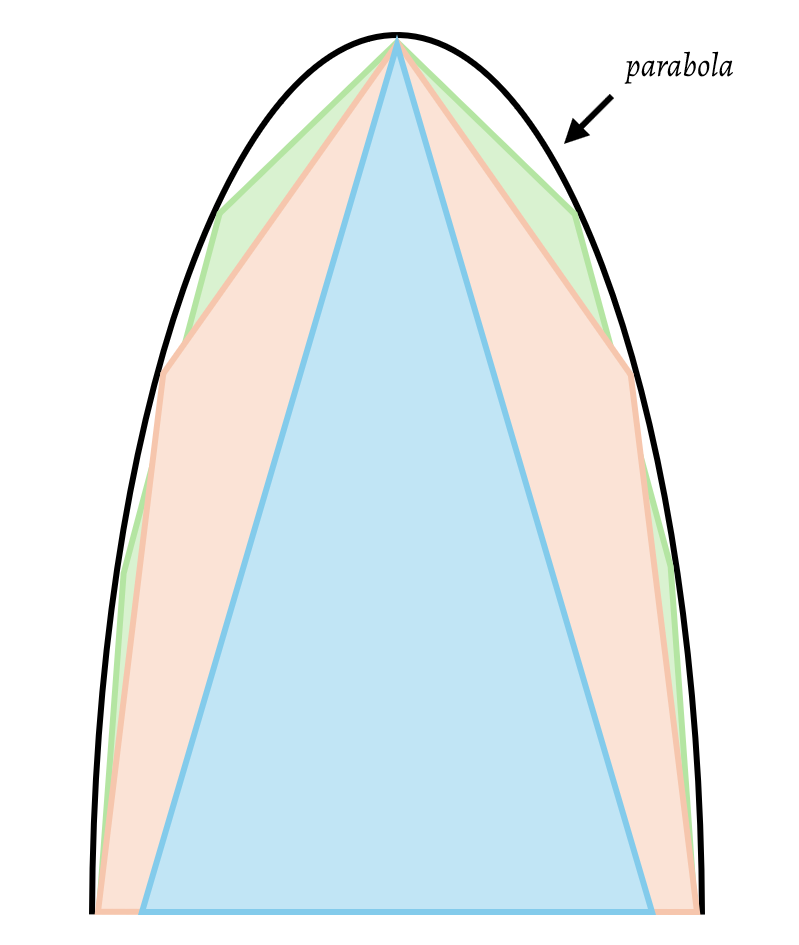
Archimedes eventually reached the point where the difference between the lower and upper bounds, or the difference between the lower bound and the shape itself, is arbitrarily small – the point of exhaustion. Sure, the exact area of the shape was still unknown, but a highly accurate approximation of it had been achieved.
Surface Area and Volume of a Sphere
It was not only 2D shapes that Archimedes was interested in: he also worked on spheres.
He discovered that the surface area of a sphere is:
four times greater than the area of a circle with the same radius, thus making the formula for finding spherical surface area 4πr^2.
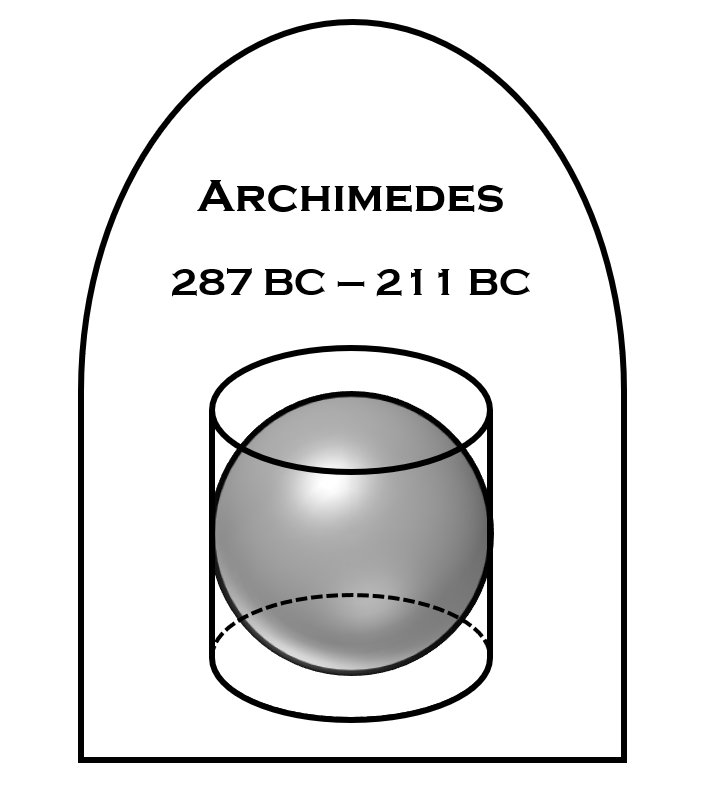
two-thirds the surface area of a cylinder with a circular base of the same radius.
He also discovered that the volume of a sphere is similarly two-thirds the volume of a cylinder with a circular base of the same radius.
Archimedes was so proud of these particular discoveries that he asked for an image of a cylinder circumscribing a sphere to be engraved on his gravestone.
Archimedes’ Screw
Archimedes is the eponymous engineer credited with the invention of the Archimedes’ Screw. This device, despite not fulfilling the typical purpose of fastening things together, is called a screw due to its shape and movement. The Archimedes’ Screw is a surface with a spiral ridge that rotates inside a pipe, lifting water from one end to the other. This allows water to be transferred and raised to higher levels. The device has been used a great deal over hundreds of years in irrigation, drainage, and sewage systems, contributing considerably to agriculture and wastewater treatment. Modern versions are still used today.
On account of its size, it is said that the Syracusia experienced extensive water leakage through its hull, and that Archimedes invented the screw to combat this issue. The Archimedes’ Screw, operated by a single crew member, would make it possible for large amounts of water to be drained from the bilge – the part of the ship that collects unwanted water. However, some scholars suggest that the device predates Archimedes, and that Archimedes only improved upon an existing design. We may never know the screw’s full history!
Archimedes’ Law of the Lever
Most of the origin stories for Archimedes’ various scientific breakthroughs centre round the Syracusia. Archimedes’ Law of the Lever is no exception. It is posited that this theory was born from another of King Hieron II’s requests; this time, to find a way of getting the Syracusia into the water.
The story goes that, impressed by Archimedes’ work in On the Equilibrium of Planes, King Hieron II challenged Archimedes to a practical demonstration of his claims on mechanical advantage. Can substantially heavy objects be moved without substantial force? Supposedly, Archimedes masterfully applied his theoretical understanding, created a system of pulleys, and succeeded in single-handedly transferring the ship into the sea.
However, it is unlikely that it was quite this straightforward; accounts of this event were written hundreds of years after Archimedes’ death. While Archimedes’ Law of the Lever almost certainly played an important role in the Syracusia’s launch, this extraordinary feat was probably exaggerated.
That said, what exactly is Archimedes’ Law of the Lever?
The idea is that a small force on a lever at a large distance from the fulcrum – the support on which the lever rests – creates a greater force at a shorter distance on the other end. Two objects will be in equilibrium when their distances from the fulcrum are inversely proportional to their weights. In other words, to balance two objects perfectly, the product of the first object’s weight and its distance from the fulcrum must be equal to the product of the second object’s weight and its distance from the fulcrum.
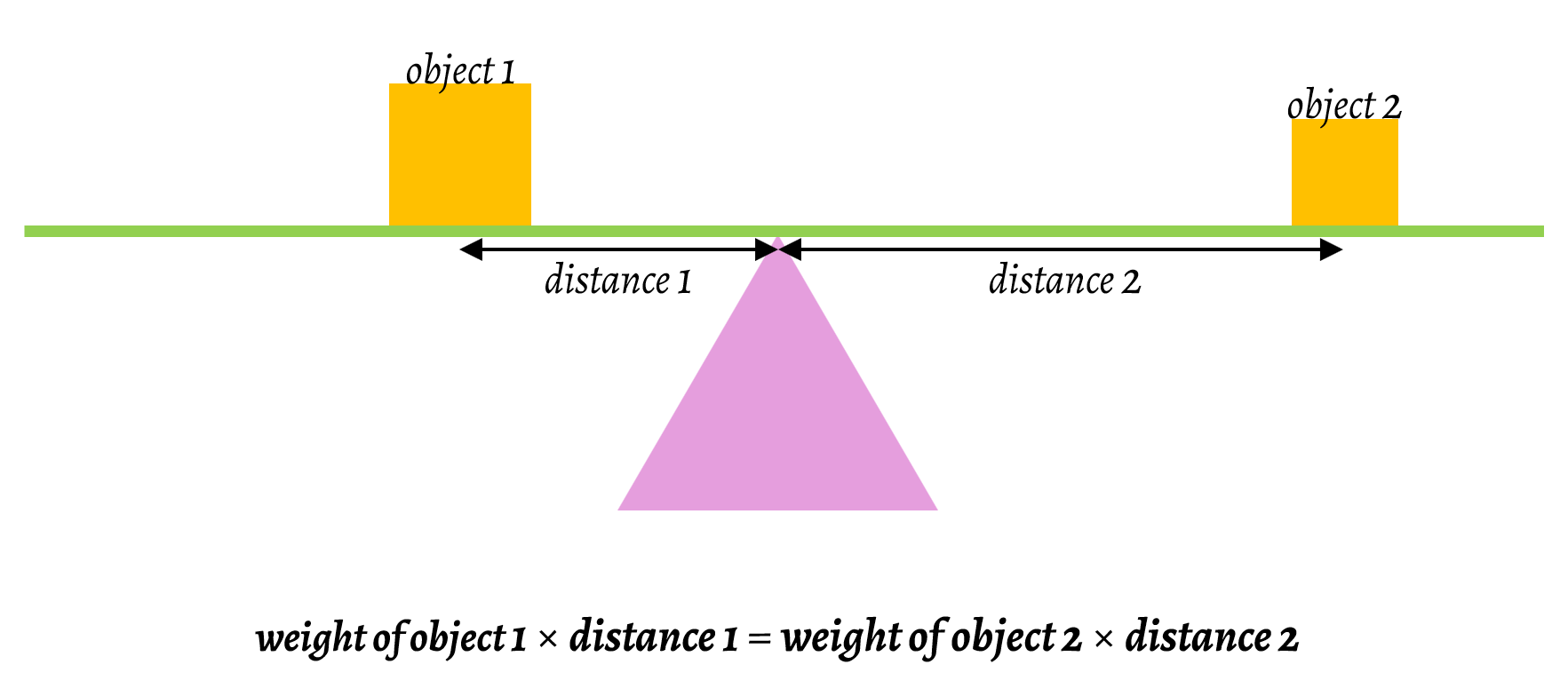
This theory is the linchpin of our understanding of mechanical advantage and the foundation of many machines to this day, including cranes!
Large numbers
Archimedes also came up with a pretty neat system of representing super large numbers, like the total grains of sand needed to fill the universe. To most GCSE maths students, this may seem easy. We can add zeros or use standard form (a × 10^n) to express numbers as big or small as we like. However, in the third century BC, a lot of the maths that underpins the modern numeral system and standard form had not been invented yet. For example, the ancient Greeks used the Ionian numeral system (otherwise known as the Ionic, Milesian, or alphabetic numeral system), which uses letters in the Greek alphabet to represent numbers. Alpha (α) was 1, beta (β) was 2, and so on. Our current numeral system, on the other hand, is positional, using a base of 10. This means that we can represent any natural number using 10 digits: 0, 1, 2, 3, 4, 5, 6, 7, 8, and 9, where 0 is used both as a number and as a placeholder. The position of a digit in a number dictates its value – the ‘3’ in 35 has a value of 30, whereas the ‘3’ in 350 has a value of 300. Archimedes, in his quest to represent super large numbers for which specific terms had not been coined, made use of ‘myriad’, the Greek word for the number 10,000. Whereas modern standard form is based on powers of 10, Archimedes’ proposed system was based on powers of myriad myriads, which we understand as ten-thousand ten-thousands, 10,000 × 10,000, or 100 million. In this way, Archimedes’ system of representing super large numbers is a precursor to modern standard form. He realised that having a name for each number is not up to the challenge of counting past the everyday. For this, humans would have to make use of scale, and Archimedes did just that!
Outro
I have covered several of Archimedes’ main contributions to science and maths here, but there are many more – he was a prolific academic. For example, Archimedes was also able to accurately approximate square roots – no surprise there, what couldn’t he approximate? – and explored what is called Archimedes’ Spiral, another significant gift to geometry!